
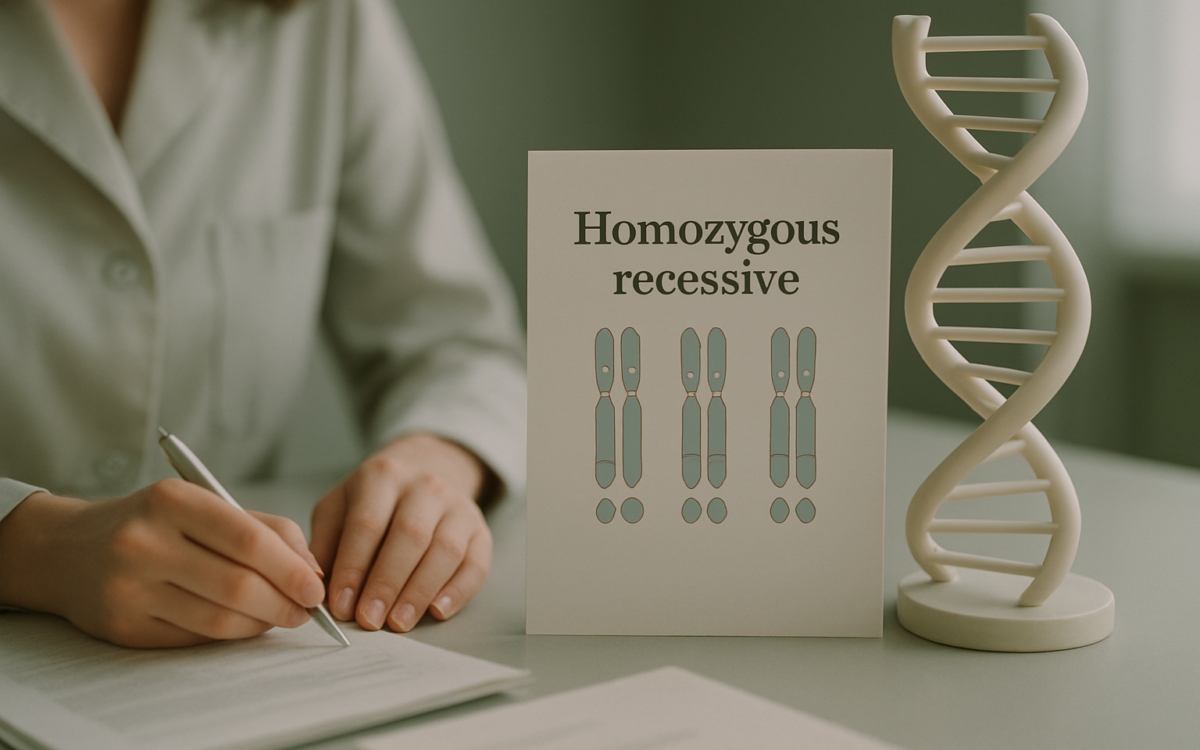
When it comes to understanding genetics, some terms can be a bit daunting. One such term is “homozygous recessive.” This concept revolves around how particular traits are inherited and can contribute to various health conditions. Understanding what it means to be homozygous recessive can help us grasp how genetics play a crucial role in our lives.
What Does Homozygous Recessive Mean?
The term “homozygous” refers to having two identical alleles for a gene on both copies of a chromosome, while “recessive” indicates that the trait will only be expressed if both alleles are the recessive variant. In simpler terms, if both copies of a gene carry the same recessive trait, the characteristic linked to that trait appears in the individual. For example, consider a gene for eye color. If there are two alleles—one for brown eyes (dominant) and one for blue eyes (recessive)—a person must have two blue eye alleles to actually have blue eyes.
How Inheritance Works: Understanding Alleles
To grasp the full meaning of homozygous recessive, it’s important to understand alleles. Alleles are different versions of a gene. Each person inherits one allele from each parent. This means that a child might inherit a dominant allele from one parent and a recessive one from the other, resulting in a heterozygous condition. In contrast, if both parents pass on a recessive allele, the child becomes homozygous recessive.
Example of Inheritance
Let’s look at a common genetic scenario involving a trait such as cystic fibrosis. Cystic fibrosis is caused by a mutation in the CFTR gene, which is autosomal recessive. A person must inherit two defective copies of the CFTR gene—one from each parent—to develop the disorder. Individuals with only one defective copy are carriers of the condition (heterozygous) but do not exhibit symptoms because the normal allele is dominant. This highlights how recessive conditions require both alleles to be homozygous recessive to manifest.
Health Implications of Homozygous Recessive Conditions
The implications of being homozygous recessive can vary widely depending on the gene involved. Some homozygous recessive traits are benign, while others can lead to serious genetic disorders. For example:
- Sickle Cell Disease: This is a severe blood disorder that occurs when a person inherits two sickle cell alleles. Individuals with this condition have misshapen red blood cells that can lead to infection, pain, and other complications.
- Phenylketonuria (PKU): This metabolic disorder arises when both alleles for the PAH gene are defective. This leads to an inability to break down phenylalanine, which can cause cognitive impairments if not managed through diet.
- Tay-Sachs Disease: An example of a condition with tragic implications, Tay-Sachs occurs in individuals who are homozygous recessive for a specific gene on chromosome 15, leading to severe neurological degeneration.
Screening and Genetic Testing
As genetics continue to evolve as a field, screening for homozygous recessive conditions has become a critical aspect of preventive health. Genetic testing can identify carriers of recessive alleles, providing invaluable information especially for couples planning to have children. Through genetic counseling, individuals and families can understand their risks and make informed decisions.
The Role of Genetic Counseling
Genetic counselors are trained to help families navigate the complex world of genetics. They can provide information about:
- Risk assessment for various genetic conditions
- Testing options available for identifying homozygous recessive traits
- Implications of test results for family planning and health management
With the advancement of technology, reproductive options, including in vitro fertilization (IVF) with preimplantation genetic testing, allow parents to select embryos that do not carry certain homozygous recessive traits.
Living with a Homozygous Recessive Condition
If someone is diagnosed with a homozygous recessive condition, management and treatment options can vary based on the specific disorder. Some conditions may require regular medical care, lifestyle changes, and support from healthcare professionals, family, and community resources. For instance, individuals with cystic fibrosis often need specialized care to manage lung function.
Support and Resources
For those living with a homozygous recessive condition, support networks and organizations can be invaluable. These resources can provide:
- Emotional support from others facing similar challenges
- Information about the latest research and treatment options
- Advocacy for better healthcare policies and access to care
When to See a Doctor
If you or a family member has concerns about genetic disorders, it may be wise to consult a healthcare professional. Signs that you should seek help include:
- A family history of genetic disorders
- Unexplained health issues that may have a genetic component
- Questions about genetic testing or implications for family planning
A doctor can guide you through the appropriate next steps, which may include referrals to genetic counseling.
Conclusion
Understanding homozygous recessive traits is vital for grasping how genetics affects our health. As science continues to unfold the mysteries of our DNA, staying informed about genetic conditions can empower us to make better health choices for ourselves and our families. Whether you’re considering family planning or navigating a diagnosis, knowledge is a cornerstone of effective healthcare.
